Council Grants and Community Infrastructure Funding: Plan Your Park Project
Explore community infrastructure funding for parks, playgrounds and recreation. Check grant pathways, see Anzac Park and prepare your project brief.
Moduplay is the first playground manufacturer in Australia to implement ‘SA HB 244:2025, Supplementary guide to AS 4685.3:2021 – Giant tube slides’ – the new industry guidance specifically addressing the design, installation, and safety communication of giant tube slides. The handbook adds guidance for design verification, certification, testing and inspection alongside the relevant AS 4685 playground equipment requirements.
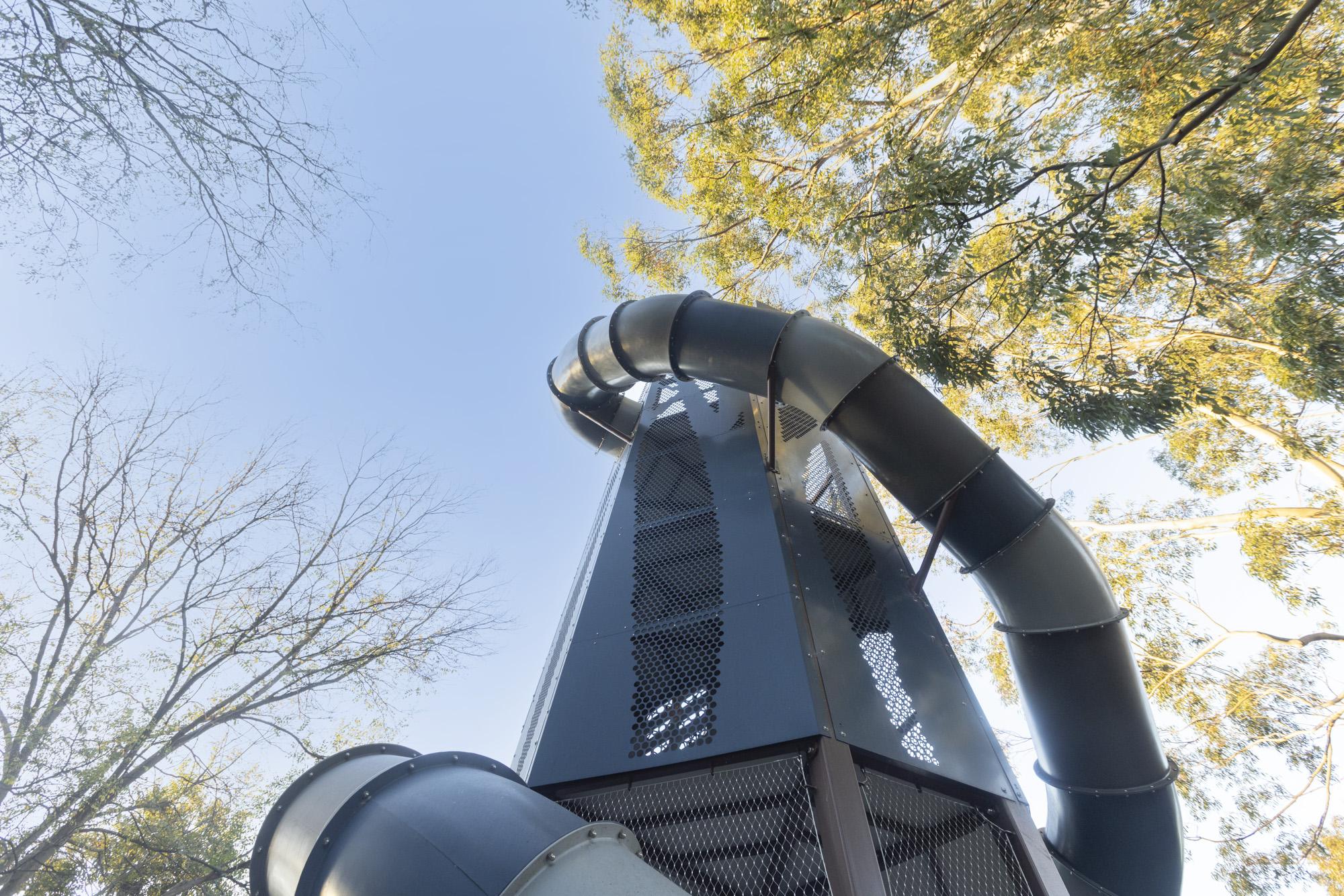
SA HB 244:2025 provides supplementary guidance for giant tunnel slides with sliding sections of 7.5m or more. It complements AS 4685.3:2021 rather than replacing it or creating a separate mandatory certification regime.
The guidance focuses on project-specific engineering, including slide geometry, speed, friction, bends, runout performance and environmental conditions. It also encourages suitable access controls, anti-climb measures, alternative play opportunities and clear safety signage.
Moduplay applies this guidance through engineering analysis, predictive modelling where appropriate, detailed project documentation and ongoing inspection and maintenance planning.
SA HB 244:2025, Supplementary guide to AS 4685.3:2021 – Giant tube slides, responds to safety issues associated with giant tunnel slides. The handbook supplements the existing requirements. It does not replace AS 4685.3:2021 or the wider standards that apply to the playground.
These issues include:
SA HB 244:2025 is a handbook rather than a standalone mandatory Standard. Standards Australia publications are generally voluntary unless they are incorporated into legislation, regulation, a contract or a project specification.
The handbook supplements the AS 4685 series. It does not replace the applicable requirements of AS 4685.3:2021 or create a separate certification regime.
The handbook also references AS ISO 4980 benefit-risk principles informatively. These principles provide useful context for balancing the developmental value of challenging play with reasonable measures to reduce foreseeable injury.
See how elevated play, enclosed tube slides and alternative play experiences were integrated at the Somerville Park giant tunnel slide project.
The handbook defines a giant tunnel slide as a tunnel slide with a sliding section measuring 7.5m or more in length.
Its application still needs to be assessed within the scope of the AS 4685 playground equipment series and the requirements of the individual project.
Councils, landscape architects, developers and certifiers should identify the applicable requirements during concept development. The type of facility alone does not determine whether every requirement applies.
A giant tunnel slide requires more than a routine post-installation inspection. Its performance depends on the interaction between the complete slide geometry, materials, users and operating environment.
Technical assessment may need to consider:
Moduplay uses project-specific engineering analysis, including predictive modelling where appropriate, to assess descent velocity, centrifugal loading and deceleration across selected user masses and friction conditions.
This modelling is a Moduplay engineering method used to support design development and the project certification process. The handbook does not prescribe one universal dynamic-simulation method.
Appendix A of SA HB 244:2025 is informative. It supports competent design verification and consideration of slide parameters, but it should not be described as imposing one mandatory calculation or simulation process.
Slide geometry directly affects speed, lateral movement, acceleration and deceleration.
Design development should assess the slide as one continuous system rather than treating individual dimensions in isolation. A dimension that performs appropriately in one layout may produce a different result when combined with another gradient, material, bend or transition.
The handbook’s design interventions include bend centreline radii greater than 1.2m. Detailed requirements for straight sections, opposing bends, transitions, declination and runout geometry should be checked against the licensed handbook and the approved engineering documentation for each project.
The runout should be designed to manage the rider’s remaining velocity and provide a stable exit. Moduplay assesses runout performance as part of its project-specific engineering process rather than attributing a universal terminal-speed requirement to the handbook.
Performance can change after installation.
Standards Australia identifies usage patterns, surface wear, climate and loose materials carried into the slide as factors that can affect the user experience. Water, sand and other contaminants can alter the friction between clothing and the slide surface.
Site planning should therefore consider:
Where the exterior of the slide is accessible, the project team should assess fall heights and impact-attenuating surfacing against the applicable requirements. Anti-climb barriers can also help deter unintended access to external slide sections.
SA HB 244:2025 encourages ability filters of varying complexity to limit unintended access by users who may not be physically or developmentally ready for a giant tunnel slide.
An ability filter is not one prescribed obstacle or universal dimension. Its effectiveness depends on the complete access route, the intended users and whether another person could assist or carry a less able user through the route.
Potential access strategies may include:
The selected strategy should be developed and assessed as part of the complete structure.
Where access to a giant tunnel slide is intentionally challenging, the surrounding playspace should also provide meaningful alternatives. Smaller slides can offer younger children and children with different abilities an appropriate sliding experience without encouraging them to bypass the intended access route.
Clear visual signs can reinforce the intended use of a giant tunnel slide.
Recommended safety messages include:
Signs should use clear pictograms supported by concise text. Their position, visibility and reading height should be considered as part of the complete playspace design.
Asset owners may also choose to install QR codes linking to user information, inspection records or incident-reporting forms. QR reporting can support local education and data collection, but it is an implementation option rather than a specific requirement of SA HB 244:2025.
Before approving a giant tunnel slide, specifiers and certifiers should request a documented design schedule that identifies:
These details give the certifier and asset owner a clearer basis for assessing the complete slide rather than relying on a general statement of compliance.
Moduplay considers SA HB 244:2025 during the design, engineering, manufacturing and documentation of applicable giant tunnel slide projects.
The project team provides the design and engineering information needed for the certifier and asset owner to review the slide against:
This approach supports a clear certification pathway and more complete asset records without overstating the legal status of the handbook or claiming a separate form of handbook certification.
Planning a giant tunnel slide? Speak with Moduplay’s playground design team early to confirm the site, access, engineering and certification requirements for the project.
SA HB 244:2025 is a Standards Australia handbook providing supplementary guidance for giant tunnel slides. It covers design verification, certification, testing and inspection in addition to the applicable AS 4685 playground equipment requirements.
Project requirements vary by site, equipment and risk assessment. Seek project-specific advice from suitably qualified designers, inspectors and the relevant asset owner.
SA HB 244:2025 is a handbook, not a standalone mandatory Australian Standard. Its guidance may become a project requirement when referenced by legislation, regulation, a contract, an approval authority or a project specification.
Project teams should confirm the requirements applying to their location and procurement arrangement.
The handbook defines a giant tunnel slide as a tunnel slide with a sliding section measuring 7.5m or more in length.
Its application should still be assessed within the scope of the AS 4685 playground equipment series and the requirements of the individual project.
No. The handbook supplements AS 4685.3:2021 and the wider AS 4685 series. It does not replace the applicable Australian Standard or create a separate form of handbook certification.
Speed cannot be assessed from slide height alone. Engineering analysis may consider the complete geometry, gradients, bend radii, transitions, runout, slide material, user mass, clothing friction and environmental conditions.
Moduplay uses project-specific engineering analysis, including predictive modelling where appropriate, to assess velocity, centrifugal loading and deceleration. SA HB 244:2025 does not prescribe one universal simulation method.
An ability filter is a physical challenge within the access route that helps limit unintended access by users who may not be ready for the giant tunnel slide.
SA HB 244:2025 encourages ability filters of varying complexity. It does not prescribe one universal obstacle or require the same configuration for every access route.
Not when the complete playspace provides meaningful alternatives. A challenging access route to a giant tunnel slide can be balanced with smaller slides, accessible activities and play experiences suited to different ages and abilities.
Learn more about inclusive playground design.
Recommended messages include riding one person at a time, sliding feet first, not braking or stopping inside the slide and waiting for the previous rider to clear the runout.
Signs should also indicate that users should be at least 1.2m tall and should not climb inside the slide or on its exterior.
Not automatically. An existing slide should be assessed by a competent person against the applicable standards, the handbook guidance, its current condition and its operating environment.
The assessment may identify changes to access, signage, geometry, anti-climb protection, inspection practices or surrounding site conditions.
No. Asset owners may choose to use QR codes linking to user information or incident-reporting forms, but QR codes are an optional implementation tool rather than a specific handbook requirement.
The design documentation should identify the slide length, descent height, material, declination, straight sections, bend radii, transitions, runout, intended users and access strategy.
It should also define the engineering verification, certification, inspection and maintenance requirements for the completed asset.
Moduplay considers the handbook during the design, engineering, manufacturing and documentation of applicable giant tunnel slide projects.
The project documentation supports assessment against the applicable AS 4685 requirements, the project brief and the supplementary guidance in SA HB 244:2025.
Contact Moduplay’s playground design team to discuss the requirements for a giant tunnel slide project.
Get design inspiration, business tips and new product alerts straight to your inbox with our Moduplay Newsletter, the Playground Press once a month.
Just Launched

The world of Moduplay has just been unlocked. One login across the Moduplay Group, helping you find what you need faster than ever.
 One login across our websites
Pricing on the Moduplay and Kaebel Leisure websites
Resource downloads
Build your own designs on Playfigurator
More coming soon!
Approval criteria applies. UrbanFiT & Playground Parts SSO experience launching soon.
Before You Continue
Register for a Moduplay account to see pricing on 500+ Australian Made products, and build your quote in seconds.
Pricing on 500+ Australian Made products
One login for the Moduplay Group websites
Build your own designs on Playfigurator

Enter your email to sign in or create an account.