
School Playground Equipment
In Australian schools, playground time supports physical health, social development and student wellbeing as part of the school day. Selecting outdoor play equipment for schools means planning for heavy use across multiple year levels, mixed abilities, limited supervision, duty of care obligations and finite budgets. Moduplay designs, engineers, manufactures and installs commercial school playground equipment for Australian schools, backed by more than 35 years of experience delivering school projects across every state and territory. This page explores age zoning, timber and challenge-based options, compliance, and the steps from concept to handover.
School projects often start with Modular Multi-Play Structures, then expand with Climbing Equipment and Adventure & Ninja Play. Other common inclusions include Rope Play Structures, Timber & Nature Play, Swings, Inclusive Play Equipment, and Sports Play Equipment.
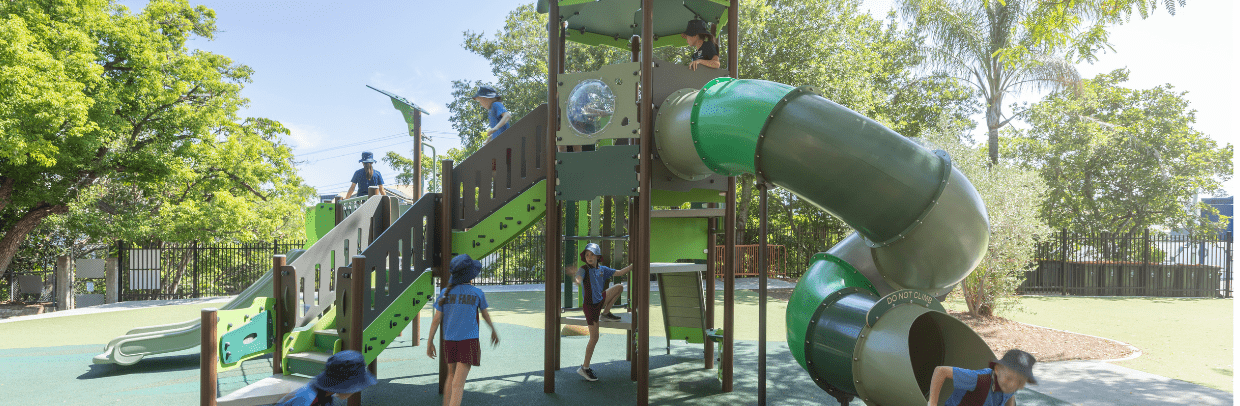
Playground Equipment by Year Level Matching the Challenge to the Child
Good school design starts with clear age zoning. Outdoor school play equipment that suits a six-year-old can fall short for a Year 6 class, and placing high-challenge equipment near younger students can create safety risks. Moduplay designs usually group play into three zones, early primary, upper primary, and secondary.
Early Primary Foundation Year to Year 2 Ages 5 to 7
Children in Foundation to Year 2 need lower platforms, shorter bridges, sensory touchpoints, and space for role play. Smaller multiplay units and themed structures support gross motor development, coordination, turn-taking, and confidence in spaces that teachers can supervise easily. An Early Primary School Concept shows how compact modular play fits within a school setting.
Upper Primary Years 3 to 6 Ages 8 to 12
This age group often drives the largest investment in Australian primary schools. Larger multiplay structures, Skyclimber systems, Wild Ninja elements, and varied climbing routes keep Years 3 to 6 engaged. These features support climbing, balance, grip strength, and decision-making, while encouraging social play and managed risk.
Secondary and Upper School Ages 12 Plus
Older students respond to challenge, pace, and choice. School adventure playground equipment for this group often includes ninja runs, rope structures, fitness stations, and open social areas where students gather between activities. Wild Ninja and sports-focused elements work well, especially when schools want spaces that encourage teenagers to stay active. AIHW reporting shows only 11 percent of Australians aged 15 to 17 meet activity guidelines, which highlights the need for purposeful design in upper school environments.
Adventure Playground Equipment Challenge, Risk, and Resilience
Adventure playground equipment for schools gives students clear physical challenges through climbing, traversing, balancing and obstacle-style movement. For schools, that matters because physical challenges build strength, confidence, problem-solving and physical literacy. Moduplay addresses this need with Wild Ninja, Skyclimber, GeoClimber and Connect Adventure systems. It also helps fill a common gap in school play provision, especially for upper primary and secondary students who look for more challenge during recess and lunch breaks.
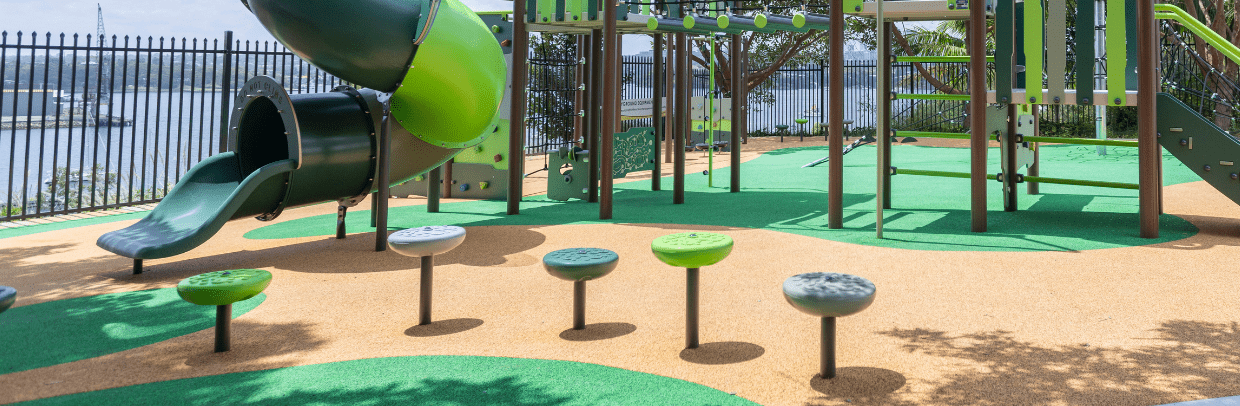
Ninja and Obstacle Course Equipment for Schools
Wild Ninja suits Years 3 to 12 and gives schools rope climbs, monkey bars, traverse routes, obstacle runs and balance challenges within a single range. The Wild Ninja range works especially well when students prefer challenge-based play instead of traditional swings and slides.
Rope Play Structures
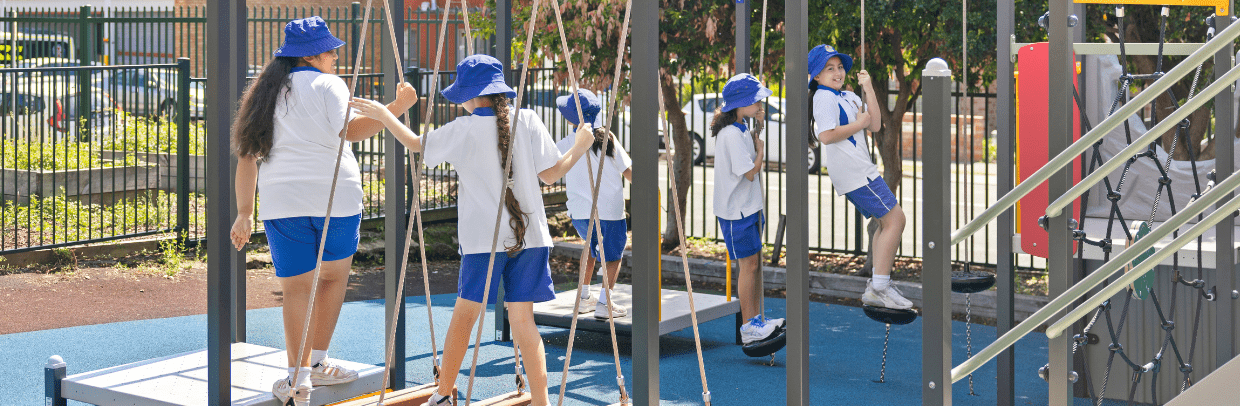
Skyclimber and GeoClimber systems allow multiple students to use the equipment at the same time through open, platform-free climbing routes. That keeps play opportunities high per square metre while improving spatial awareness, grip strength and full-body coordination. See the Skyclimber Rope Systems for examples.
Wooden Play Equipment for Schools: The Case for Timber
Schools keep asking for wooden play equipment for schools because timber changes the look and feel of a school yard. It adds texture, supports nature play and gives landscaped campuses a stronger connection to outdoor learning while still meeting commercial requirements. Moduplay’s Bushwood range uses sustainably sourced Australian timber and is designed and manufactured in Australia, and the range suits schools that want a more natural visual fit with planted grounds. For high-UV or coastal sites, timber-look aluminium gives schools a lower-maintenance way to keep that natural look.
Schools often ask if wooden play equipment for schools can stand up to daily use. In commercial settings, it can, provided the specification includes seasoned timber, fit-for-purpose treatment, UV exposure and regular inspections.
Nature Play and the Australian Curriculum
Nature play aligns well with curriculum priorities around outdoor learning, sustainability and wellbeing. The Bushwood Timber Range helps schools create spaces that support movement, open-ended play and outdoor teaching opportunities, rather than simply changing the look of the space.
Safety, Compliance, and Duty of Care for School Playgrounds
Safety and compliance are central to commercial school playground equipment. Moduplay designs to AS 4685:2021 and plans surfacing to AS 4422, which matters in busy school environments where fall risk and surface wear remain high. Education departments around Australia reference these standards in their own guidance, so compliance documents help principals and business managers complete procurement sign-off more smoothly.
Fixed playgrounds also fall within the Class 10b classification framework under the National Construction Code, so schools need proper records, inspections and maintenance from day one. Duty of care does not stop after installation, and Moduplay supports that with spare parts availability for at least 10 years after discontinuation plus archived project details for future repairs, audits and upgrades.
Budgeting for a School Playground: What to Expect
Cost usually comes up early in the conversation for principals, business managers and P&C teams. Smaller outdoor play equipment for schools projects often start in the lower tens of thousands, mid-range school playgrounds increase in cost as schools add surfacing and installation, and larger projects cost more again once shade, access works and complex site conditions become part of the project.
Equipment choice, site size, ground conditions, soft-fall type and installation complexity all shape the final figure. Funding often comes through P&C or P&F fundraising, school capital works programs, community grants and Commonwealth support. The School Playground Cost Guide offers a clearer breakdown of common budget ranges.
From Consultation to Installation: How Moduplay Works with Schools
School projects run more smoothly when the supplier understands school approvals. Moduplay starts with consultation, then site assessment, concept design, quote, manufacturing, delivery, installation, safety inspection and handover. That process works well for principals, assistant principals, business managers and P&C or P&F committees because each stage gives the school a clear next step to review and approve.
A project manager oversees site set-out and final details, while a trained installation team carries out on-site work across Australia. Archived project details and long-term spare parts support also help schools manage future upgrades more easily.
Australian-Made, Built for School Environments
Moduplay designs, engineers and manufactures playground equipment in Wollongong, NSW, and has been doing so since 1989. HDPE, powder-coated aluminium and steel, and sustainably sourced Australian timber help school playgrounds stand up to heavy daily use, strong UV and different Australian climate conditions, while supporting Australian manufacturing.
Frequently Asked Questions
Primary schools benefit the most from age-zoned layouts, with lower-scale play for Foundation to Year 2 and higher-challenge modular, rope and adventure play for Years 3 to 6, all built in commercial grades that comply with AS 4685:2021.
Adventure playground equipment includes ninja and obstacle courses, rope climbing systems, traverse routes and climbing frames that develop strength, coordination, confidence and resilience.
Commercial school playground equipment is built for continuous multi-child use and must meet AS 4685:2021. Residential is not suitable for school settings or the volume of daily student use.
Yes. Commercial timber systems such as Bushwood offer outdoor durability, nature-rich play and AS 4685:2021 compliance when schools follow the right inspection and maintenance schedule.
Costs change with equipment, surfacing, site conditions and installation complexity. The dedicated school playground cost guide breaks down typical budget ranges in more detail.
Yes. Moduplay works with P&C committees and business managers on grant-funded projects and can help scope the project and prepare the documentation often needed.

 One login across our websites